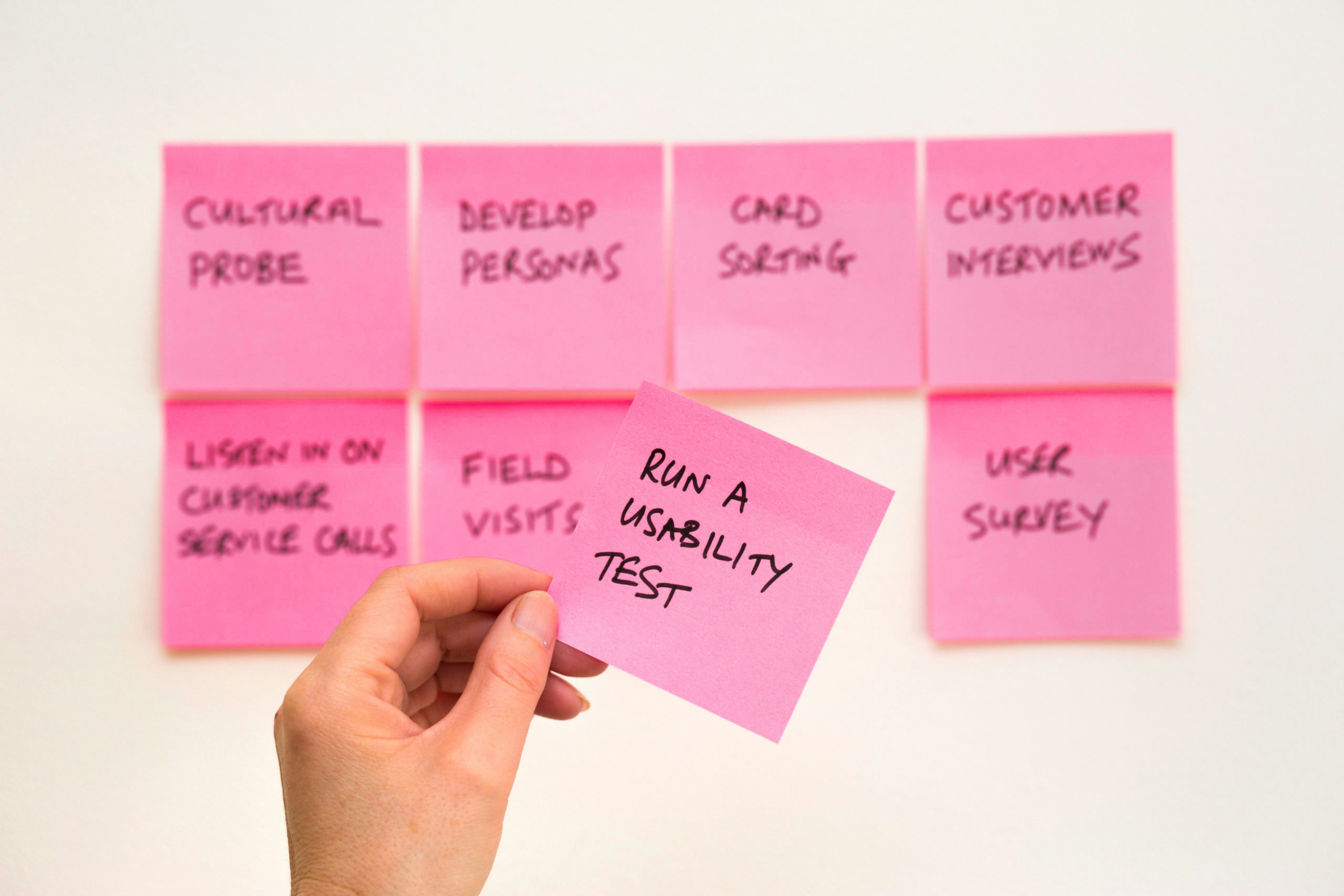
Methods, frameworks, metrics, and best practices for effective user research

The strongest business decisions start with a clear understanding of customers. Real people and their needs can't be captured by personas, assumptions, and internal opinions alone. The deep understanding needed to create products and experiences that shift markets requires getting close to the users themselves.
The best way to do that is through user research.
What is user research?
User research is the process of understanding who your customers are and what they want. Through a combination of methods, brands can tap into what their customers are looking for, how they experience a product or service, and which new directions to invest in or explore.
What's the difference between user research and UX research?
User research is a broad discipline focused on understanding the people who use or may use a product, including their needs, motivations, and behaviors. UX research is a subset of user research focused on improving product experiences, such as usability, navigation, onboarding, and task completion.
The most common user research methods: qualitative vs quantitative
The two primary user research methods are qualitative (which uses conversations and descriptions) and quantitative (which uses large numbers of responses to validate trends).
But before choosing a method, teams need to answer a prior question: what stage of understanding are we in? This determines whether the research should be generative or evaluative.
Generative vs. evaluative research
Generative research is conducted early, when the goal is discovery. It helps teams uncover unmet needs, unarticulated motivations, and new opportunities before a product or feature direction has been committed to. The question it answers is: what should we build, and for whom?
Evaluative research is conducted once something exists. It answers: is this working, and what needs to change? Most quantitative methods are inherently evaluative. Most qualitative methods can serve either purpose depending on how they are designed.
Qualitative methods
In-depth interviews (IDIs)
A one-on-one conversation in which a researcher asks participants a structured but open-ended series of questions about their behaviors, needs, and experiences. Interviews are among the best tools for generative discovery because they reveal why people do what they do. They can also be evaluative when used to probe reactions to a specific concept or prototype. They are hard to do at scale due to budget, scheduling, and resource constraints.
Usability testing
A structured session in which a participant attempts to complete a specific task using a product, prototype, or interface while a researcher observes. This is one of the most direct evaluative methods available. Instead of asking people whether something works, your team can see it in real time.
Focus groups
Group conversations where respondents share their insights in conversation with one another. Useful for stimulus-response testing (reacting to ads, packaging designs, and so on), but unreliable for actual opinion measurement. Group dynamics often produce performative dissent or conformity to a single dominant voice.
Diary studies
Participants self-document their behaviors, thoughts, and experiences over a defined period through written logs, photos, or short videos. Diary studies are generative by design. They surface the texture of everyday behavior that a one-time interview cannot reach — moments of frustration that someone might forget in a more artificial setting, and the real contexts in which a product is used.
Ethnography and contextual inquiry
Observing how people behave in their natural environments to understand unprompted truths. This can look like observing how people behave near a brand's product on a shelf, outside a store, or in the comments of a social post.
Quantitative methods
Surveys
An evaluative tool for validating trends across large groups. Surveys can confirm how widespread a certain pain point is, measure satisfaction at scale, or track changes over time. They work best when deployed after qualitative research has identified what to measure. Corvane's survey builder is designed for exactly this — sending targeted surveys to your own opted-in customers rather than cold third-party panels, so the data you collect is clean from the start.
A/B testing
A controlled experiment in which two versions of something — a design, a message, a flow — are shown to different user groups and outcomes are compared. It doesn't explain why one version outperformed the other; it only shows that it did. Pair A/B results with qualitative follow-up when the reason behind the result matters for future decisions.
Analytics review
The analysis of behavioral data already being generated by a product. Click paths, drop-off rates, session lengths, and feature adoption curves. Analytics is evaluative and retrospective. It tells you what people did, not what they were trying to do or why they stopped. It is one of the strongest signals for identifying where to investigate next.
Benchmarking and standardized scales
Instruments like the System Usability Scale (SUS), Net Promoter Score (NPS), and Customer Effort Score (CES) provide scores that can be compared over time, across products, or between competitors. Useful for tracking health metrics and communicating findings to stakeholders who need a single number. They operate more like a thermometer than a tool for new insight.
Most teams benefit from combining methods: qualitative research to surface insights, and quantitative research to validate whether they hold at scale.
User research best practices
When to conduct user research?
User research should be an ongoing, iterative process that serves a different purpose at each phase of development.
In the early stages, user research is generative — helping identify new needs and opportunities. As an idea develops, research helps refine it. Once a product is launched, research gathers feedback for improvements or new directions. Teams that build research into their workflow at every stage shorten their decision cycles significantly.
Why user research matters
Strong user research helps teams reduce risk, validate ideas before investing heavily, improve product usability, and make decisions with greater confidence. It also creates alignment across product, design, marketing, and leadership teams by grounding debates in real customer evidence rather than internal assumptions.
How do you choose the right method?
If your team needs to understand the deeper motivations behind customer behavior, explore an ambiguous problem space, or gather nuanced feedback that won't fit neatly into multiple-choice responses, qualitative methods are often the best choice. They are also valuable when direct relationship building with participants matters.
If your goal is to validate a hypothesis or reach a large number of participants, quantitative methods are the more practical option. They were also historically selected by organizations that didn't have the time, bandwidth, or resources for qualitative work — even when qualitative would have served them better.
Traditional user research was constrained by a tradeoff between depth and speed. Qualitative methods yielded generative insights but were expensive and slow. So expensive and slow that many companies defaulted to quantitative methods for feasibility alone. Corvane is built to change that calculation.
Research at scale with Corvane
Corvane is built for brands that need continuous, high-quality feedback from the customers who already know them. Rather than sending surveys to cold third-party panels, Corvane runs research on your own internal panel — opted-in customers who have context on your brand, your products, and your category.
This matters because the quality of research data is only as good as the quality of the audience. Responses from people who have actually bought from you, used your product, and chosen to stay in your ecosystem are a different category of data from panel strangers who clicked a link for a $2 incentive.
Corvane's platform combines survey tools, video responses, AI-powered synthesis, and audience segmentation in one place. You can build a survey with visual stimuli — showing customers a real product, concept, or design before asking how they feel — and get responses back from specific segments of your audience the same day. The Co-pilot feature lets you ask plain-language questions across all your feedback data and surface insights instantly, without manual tagging or analyst time.
The result is a feedback loop that compounds. Customers who complete a Corvane survey get rewarded. That reward signals that their time is valued, which means they come back next time. Over time, your internal panel becomes a reliable, always-on research asset rather than a one-off data collection exercise.
FAQs
What's the difference between user research and market research?
Market research is concerned with the broader landscape in which your business operates — market size, competitive positioning, category trends, and product demand. User research zooms in on the individuals who use or would use a product, studying their behaviors, needs, and motivations in direct relation to specific experiences. They are complementary, and both are needed for effective product building.
What is the difference between user research and consumer insights?
Consumer insights is a broader discipline concerned with understanding why people behave in certain ways as customers: their motivations, attitudes, and purchase drivers. User research focuses on how people interact with your brand, product, or interface specifically, rather than general observations.
How many participants do you need for effective user research?
The right number depends on two things: the breadth of your research goals and the diversity of your study population. You need enough participants to reach saturation — the point at which talking to new people wouldn't add anything new. Depending on the project, that number could range from 5 to 50. Broad, exploratory studies with diverse populations require more participants. Narrow, focused studies with homogeneous groups require fewer.
How do you recruit participants for user research?
The most common approaches are using a managed research panel, recruiting from your own customer base, or working through a specialist recruitment agency. Each has tradeoffs around speed, cost, and how closely participants reflect your actual users. The most critical factor is specificity: the closer your participants match your real or intended user population, the more useful your findings will be. Corvane is built around this principle — research runs on your own customer base, not a generic panel.
How do you analyze and synthesize user research findings?
Experienced researchers identify patterns as the study unfolds. After collection, the process typically involves open coding (tagging themes across responses), affinity mapping (grouping related observations), and synthesis (drawing the insight from the patterns). The most common failure mode is stopping at a summary of what participants said rather than what it means for the decision at hand. Corvane's Co-pilot accelerates the synthesis phase by automatically clustering themes, flagging sentiment, and surfacing patterns across hundreds of responses in minutes.
Can AI replace human researchers?
No. AI is effective at tasks that have historically made research slow and expensive: transcription, pattern recognition, and analysis at scale. What it doesn't do is know which questions are worth asking, recognize the significance of an unexpected answer, or make judgment calls about what a finding should mean for your business. The most effective research programs treat AI as a force multiplier for human researchers, not a replacement.
How do you maintain research quality when using AI?
Quality in AI-assisted research depends on three things: the integrity of the study design, the quality of participants, and the rigor applied to synthesis. AI doesn't eliminate the need for clear research objectives and well-crafted questions. If the questions are weak, the data will be too. On the participant side, robust screening is essential. And even with AI-generated synthesis, a trained researcher should review and pressure-test the output before it informs a decision.
How do you measure the ROI of user research?
Start by connecting research to a specific business outcome it influenced and track what happened downstream. Did the insight lead to changes in conversion rates, reductions in development rework, improvements in customer retention, or lower support ticket volume? The cleanest ROI stories come from cases where research accelerated a successful decision. Qualitative gains — stronger team alignment, faster decision cycles, reduced internal debate — are also real returns, even when they're harder to put a number on.
How do you get stakeholder buy-in for user research?
Stakeholders who resist research investment rarely object to understanding customers. It's the slow timelines and uncertain returns of traditional research methods they're not bought into. The most effective pitch reframes research as a risk-reduction tool: what is the cost of making the wrong product decision without it? Show examples of research that directly informed a decision and produced a measurable result. When stakeholders see fast, actionable findings coming back from Corvane rather than waiting weeks for a research report, the investment case makes itself.